


Jakub Ptáček, SGA Student Chapter Prague
At the end of April 2025, the SGA Student Chapter Prague organised another of its many excursions –
this time to Zlaté Hory (Golden Mountains), located in the northern part of the Jeseníky Mountains.
The goal of the excursion was to explore local geological points of interest, including minerals of
Alpine paragenesis and those associated with the rock listvenite („krupník“ in Czech). The highlight of
the trip was a descent into the Zlaté Hory gold mine, where exploration is currently underway on a
previously unmined gold-bearing body. Nine chapter members participated in the three-day excursion,
on which members Jan Mráček, Jan Kamenský, and Michal Čurda took charge of both the logistical
coordination and the provision of expert guidance. The Zlaté Hory area geologically belongs to the
Variscan orogenic zone of the Bohemian Massif, also known as the Moravo-Silesian Zone. It lies in
the highly deformed contact zone between the Keprník and Desná units (domes). The area’s geological
evolution is highly complex and remains an active subject of scientific discussion.
From a geological perspective, the two units differ significantly and undoubtedly had distinct origins.
The Keprník Unit is composed primarily of strongly metamorphosed sedimentary and volcanic rocks,
such as paragneisses, phyllites, and amphibolites, which are characterised by a high-grade
metamorphism typical of the amphibolite facies. In contrast, the younger Desná Unit consists mainly
of weakly metamorphosed sediments, including phyllites, schists, and greenschists, corresponding to
the greenschist facies. The most widely accepted interpretation suggests that the Keprník Unit forms a
nappe structure thrust eastward over the (para)autochthonous Desná Unit.
The first stop of the excursion was the locality Sobotín, known for its well-formed epidote crystals and
as a classic site for the preview of Alpine paragenesis minerals. Although previous extensive
collecting by mineral enthusiasts has reduced the locality’s productivity, several noteworthy specimens
were nevertheless obtained for the collection. The epidote veins at this site were originally discovered
by chance during the construction of a road leading to the next stop of the excursion – the nearby
Smrčina quarry. The primary focus at this locality was the rock listvenite, which was historically
utilised in local ironworks. In addition to listvenite, collectors can also find talc and small but well-
formed magnetite crystals. The final stop of the day was the beryl-bearing pegmatites of Střelecký Důl
near Maršíkov and its surroundings. While the pegmatite at Střelecký Důl was historically mined
primarily for feldspar, the locality is best known for its exceptional beryl crystals, including occasional
aquamarine, which could reach lengths of up to 10 cm.
The second day of the excursion was dedicated entirely to the modern gold mine operated by the state-
owned company DIAMO, located in the Zlaté Hory ore district. Between 1990 and 1993, underground
mining was conducted here, targeting gold hosted in quartz veins alongside pyrite, sphalerite, galena,
and other sulfide minerals. Currently, exploration of the deposit is underway in the previously
unmined sections of the ore body due to its potential for future extraction. The investigation involves
drilling across the old mine adits to estimate the remaining reserves. According to information from
DIAMO, as of 2025, approximately 4 tonnes of gold, 500 tonnes of copper, and significant quantities
of other commodities, such as zinc, germanium, and gallium, have been identified as potential
resources.
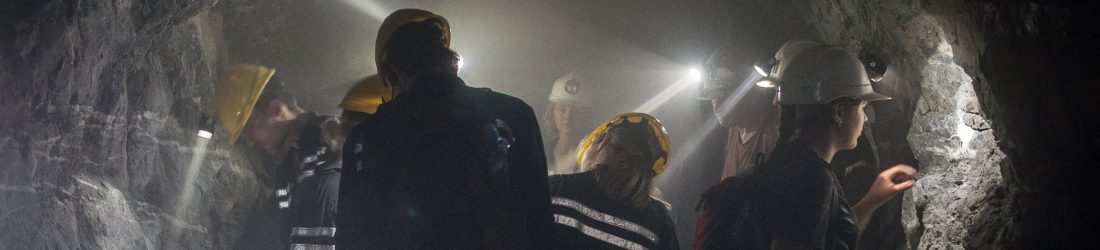
Upon arrival at the site, we received comprehensive training and were equipped with all necessary
safety gear, including a rescue breathing apparatus. In the mine, we received an overview of the
deposit along with a detailed explanation of all activities related to its exploration. They also showed
us several quartz veins filled with various sulphides, primarily pyrite and chalcopyrite, that often
contain microscopic grains of gold. Our time underground was, for safety reasons, limited, so the rest
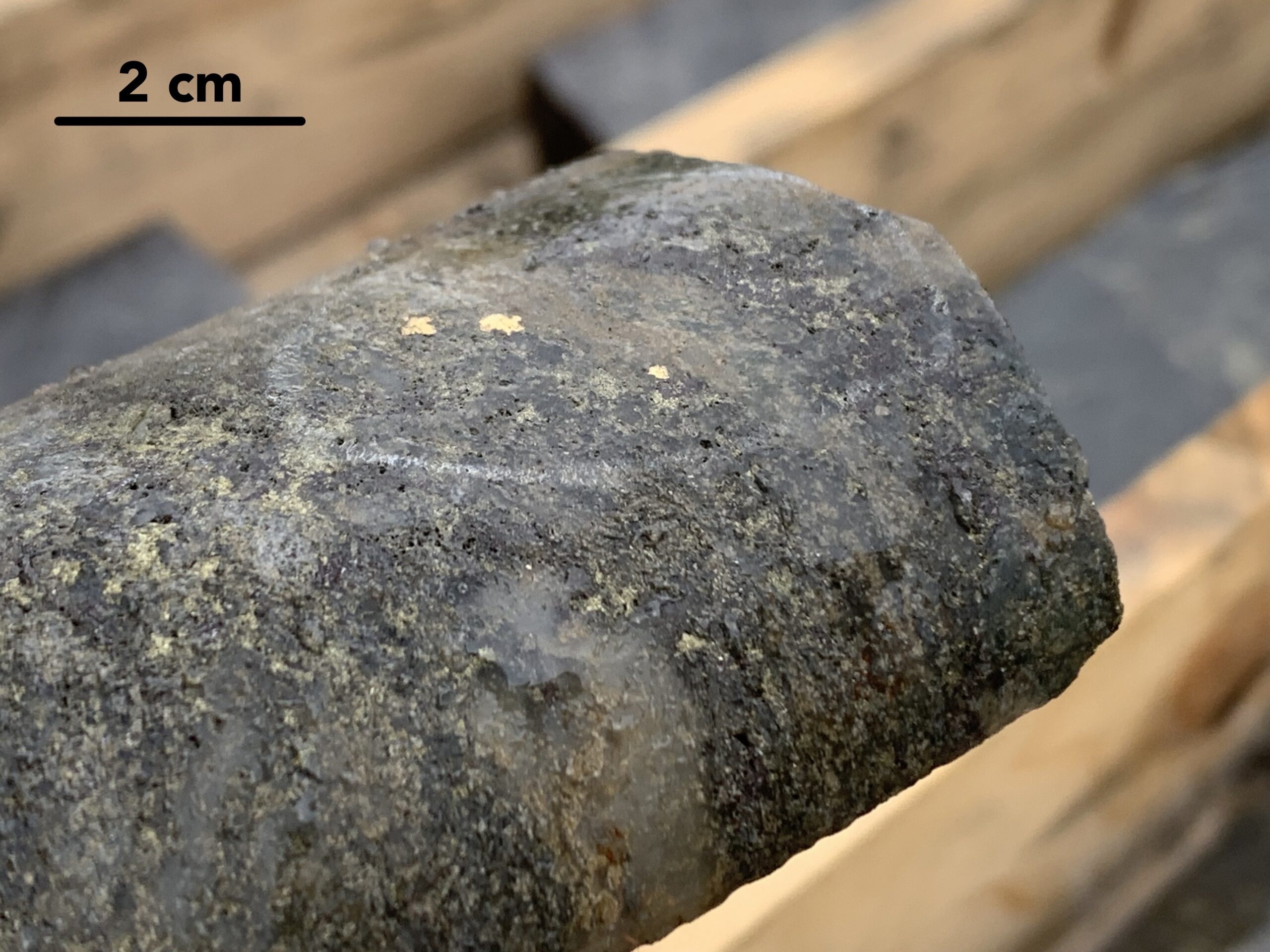
of the briefing took place in an outdoor building where DIAMO stores the drill cores from the
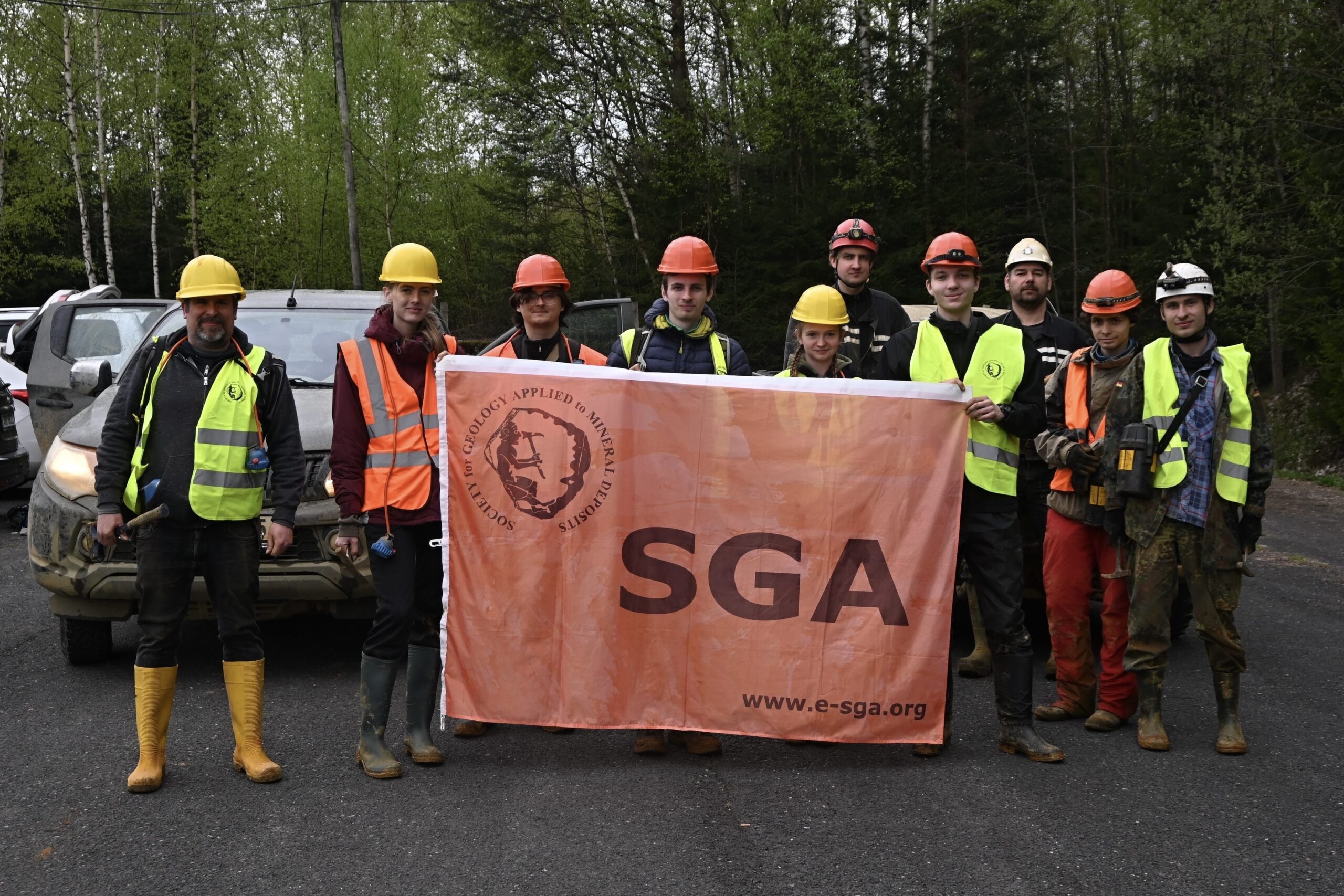
exploration (Fig. 1). Visiting the mine was an unforgettable experience for all of us, and we are very
grateful to Tomáš Žitný, as well as whole DIAMO for making it possible (Fig. 2).
At the end of the second day, we visited the nearby Poštovní štola adit from the medieval ages (Fig. 3).
The earliest records of copper and other ore mining at this site date back to the early 16 th century. This
brief stop enriched our geological knowledge with the historical development of mining in the Zlaté
Hory ore district. On the final day, we made one last stop at a marble quarry near the town of Lipová,
where we learned interesting details about the local marble, its extraction methods, and the
reclamation efforts carried out after mining operations.